

Openclaw (accidentally) created a new standard between engineers building sophisticated agents and casual users who wanted the same capabilities. Only a tiny fraction of Openclaw users knew what agent loop, tool usage, mcps, memory system means and or work. But that was the point. They weren’t expected to. They were expected to install this on a Mac Mini, copy paste a few commands and suddenly they have their very own, always available, personal assistant - right on their phones. If this is not thrilling, I don’t know what is.

I installed my first Openclaw on an old Ubuntu machine. Setup was smooth. Then I dug up a Raspberry Pi and installed Zeroclaw on it. One week later, I was spending more time on SSH gymnastics than getting work done. Tasks like upgrading the agent, configuring a new LLM provider, configuring a channel, debugging logs, etc all started eating into my limited post-day-job-time I have to play around these systems.
Then it clicked - I’m dealing with a standardization and orchestration problem here. More importantly, this is very similar to a problem that k8s solved for managing containers in production environments. Running one AI agent is easy. Running five across your network while juggling SSH keys, model configs, personas, and channel integrations is when things get messy.
I built Clawrium - an aquarium for *claws, to solve this problem. A single CLI to manage a fleet of AI Agents.
Clawrium
Clawrium is a CLI tool that provides fleet management for AI agents. . Lightweight SSH-based orchestration that lets you deploy, configure, and manage multiple agents across machines from a single control point.
Using Clawrium, you can
Deploy multiple Agents on your local network (or cloud instances)
Use a standard configuration, secrets and integrations system for all supported Agent types
Swap models, rotate secrets, update personas
Backup and restore agent memory, configuration, data and jobs
Enforce cost, token, usage guardrails on agents
Access logs, debug information and usage telemetry from a single endpoint
Remediate configuration drifts automatically
Clone agents using a central registry
… and much more
Note that this is an aspirational list which I’m excited to work on with the community!
Why Now
AI assistants are moving beyond hobby projects and solving real problems. Engineering teams I’ve interviewed for Clawrium are struggling to manage more than a single agent. They’re spending precious engineering bandwidth in agent management.
Clawrium solves their problems by letting them not just scale the number of agents but also managing them with a simple interface.
Another org is running multiple Openclaw agents, one for each of their engineering teams. Since teams manage their own instances, its an operational nightmare. 90% configuration for these agents is exactly the same: linear integrations, slack channels, confluence etc. But each team stores and manages configs, secrets and backups differently.
Using Clawrium, they’re able to pull these agents under a single umbrella.
Clawrium treats your agents as a fleet. In a pets vs cattle comparison, the agents in Clawrium are still pets. They are just pets that are well trained, on a leash, play well with each other and make your life better.
Two Use Cases I’m Building
1. Managing This Project With Its Own Agent
I run an agent on my local network that serves as the Clawrium project assistant. Through Discord, I can add issues, get status updates, and capture notes without context-switching into GitHub. The agent knows the project context and handles the logistics. As needs emerge, I extend its capabilities. If you join the Discord channel, you’ll find this bot (called Maurice) hanging around to help you. Please be nice to it.

2. Team Assistants at Work
I’m creating dedicated agents for each team at my company to work as communication and knowledge management helpers. They answer common questions, update team knowledge bases, and reduce the logistics burden on team members. Each team gets an agent tuned to their domain, ownership components and expertise.
Architecture
Clawrium has four main components
Transport layer: Built on Ansible, this layer does the heavy lifting of enforcing idempotency, transport data, manage hosts, and drift.
Configuration layer: Normalized configuration layer (similar to helm charts) for all supported Agent types.
Execution layer: Brains of the system. Merging data, creating idempotent workflows, templating, tests, domain models.
UX layer: CLI and TUI only. Keeping this layer thin to allow extension and integrations
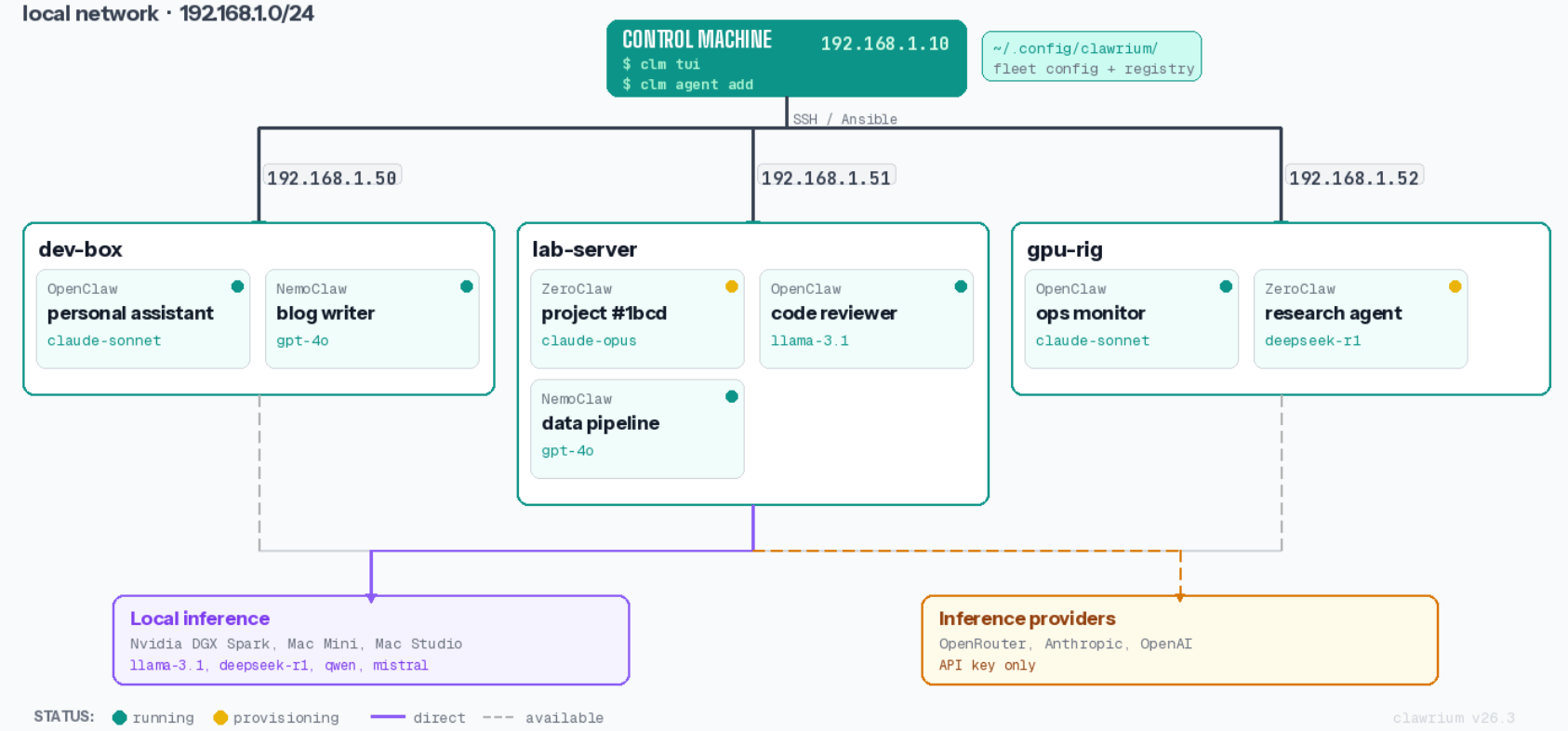
The following diagram shows a network diagram of Clawrium managing multiple agents on a local network of hosts.
Get Started
Clawrium works today on Ubuntu with OpenClaw agents. I’m expanding agent support and features based on my own requirements and requested use cases.
Clone the repo and deploy your first fleet
Join the Discord to share feedback, ask questions and connect with community
Open issues for feature requests or bugs
Clawrium is the control plane for a fleet of specialized agents working together.
GitHub: github.com/ric03uec/clawrium
Documentation: https://ric03uec.github.io/clawrium/